Home

Dog puppies: adopt littermates, a good idea?

Dog puppies: adopt littermates, a good idea?

Dog puppies: adopt littermates, a good idea?

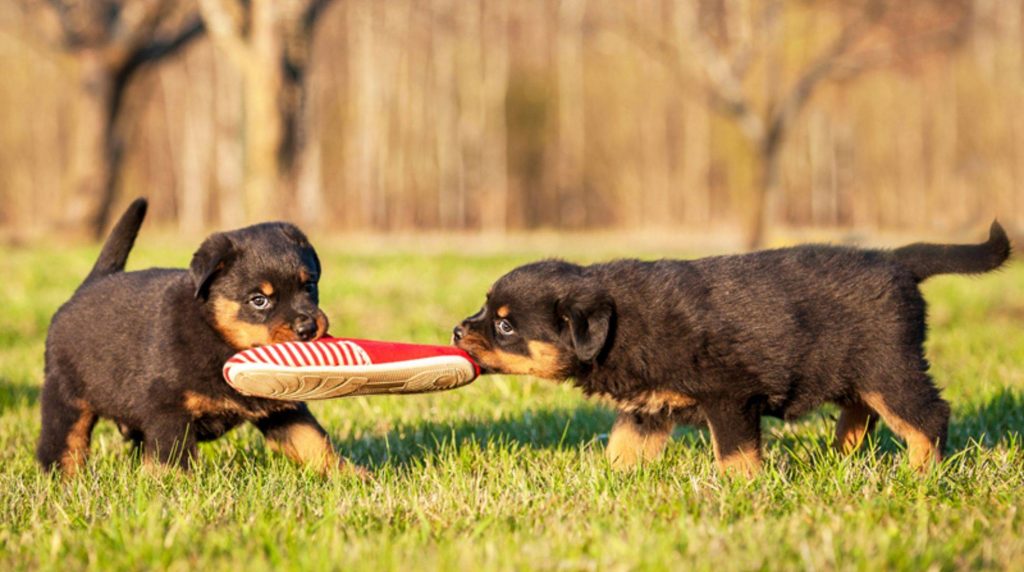
At first, it seems obvious to adopt two puppies at once. After all, littermates in particular have a close bond with each other from the start, so the dogs don’t feel so alone when their humans go out to work. But is that really such a good idea?

In English, we speak of “Littermate Syndrome” when two puppies from the same litter come into the same human family at the same time. This is a series of behavioral abnormalities that occur more frequently in littermates when they always stay together. As a result, the bond between the dog siblings is so close that they are enough for themselves, but at the same time they cannot or hardly get along without each other.

Dog puppy siblings: Barely bond with humans

Unlike cats, rabbits or guinea pigs, it is important for dogs to form a close bond with their humans. Although dogs, like cats and many small animals, organize themselves into groups or packs, they are more different from their wild ancestor, the wolf, than domestic cats are different from the dun cat or rabbits are different from the wild rabbit. The history of domestication of the wolf goes back further than that of other domestic animals, and the various breeds of dogs have been specifically bred to work with, live with, and listen to humans. For this reason, an earlier age of surrender is recommended for dog puppies than for kittens. Puppies can be separated from their mother and siblings as early as eight weeks of age, so they can finish their socialization period with humans. Kittens should ideally remain with their feline family until twelve weeks of age to develop healthy self-confidence.

If two littermates live together permanently, the puppies and later adult animals are inseparable, so to speak, and often have no desire to form a close human-dog friendship with their owners. As a result, they do not listen to their owner’s commands, do not learn to pay attention, and focus too much on their brother or sister. As a result, they may develop a fear of strange people and dogs, for example, and become frightened of unfamiliar noises, smells, and other unfamiliar stimuli. In addition, separation anxiety may occur, but not related to the human, but to the dog partner. These are then different signs of the “Littermate Syndrome”.

Two littermates mean double work

You can counteract the “Littermate Syndrome” with two puppies by raising the littermates separately. However, this invalidates the supposed advantages of adopting two dog siblings from the same litter at the same time. After all, the idea behind this is that the puppies have a playmate right away that they don’t have to get to know first, with whom they get along right away. However, this is exactly the problem, because why should your dogs listen to you and play with you and learn from you, when it is much easier and more convenient for them to play and communicate with their dog partner.

Therefore, you can’t let your two dog puppies stay too much among themselves and you need to take care of them one by one so that they form a bond with you. You must teach them the basic commands separately, as well as all the rules and prohibitions. In traffic, on the dog run, with visitors and in dangerous situations, it is essential that your dogs listen to you. To achieve this, even with a single dog is not easy and requires consistency, patience and perseverance. If you have two littermates at home, the work doubles.

Conclusion: Better to acquire a second dog later?

This does not mean, however, that it is generally not advisable to keep two dogs. Certain breeds of dogs have been bred to be happier and more comfortable with other dogs of their own species, such as beagles, which were originally designed to hunt in packs. However, it’s easier for you and for your dog if you don’t bring a second dog into your home until your four-legged friend has mastered the most important commands and has formed a trusting bond with you. You can find out what you need to consider when choosing a new four-legged friend in the guidebook “Zweithund gesucht: Which one is the best fit?”

HZOES.COM

HZOES.COM

Cute and funny, info and tips about dogs, cats and other animals. Great pictures and funny videos from the animal world. Your animals on hzoes.com

More articles from dog

Is the dog stubborn? Educate four-legged "stubborn
Dog Training

Is the dog stubborn? Educate four-legged “stubborn

Is the dog stubborn? Educate four-legged “stubborn If a dog does not obey, it is quickly called “stubborn.” However, this is a misunderstanding because the …

Read More →
Low and high stimulus threshold in dogs: what does it mean?
Dog Training

Low and high stimulus threshold in dogs: what does it mean?

Low and high stimulus threshold in dogs: what does it mean? In connection with dogs, there is often talk of stimulus threshold. But what exactly …

Read More →
This is what obedience training for the dog is all about
Dog Training

This is what obedience training for the dog is all about

This is what obedience training for the dog is all about Obedience training is often called the “high school” of dog sports. What exactly is …

Read More →
Dalmatians: nature and character of the beautiful dogs Clever, fun-loving and very active: Dalmatians charm not only with their pretty appearance, but also with their lively and affectionate nature. Who wants to acquire a dog of this breed, but should first think carefully whether the character of the four-legged friend really suits him. In order to find out, you should inquire well about the nature and the optimal keeping conditions of a Dalmatian before the acquisition. Of course, each Dalmatian is individual, but you will find the characteristics discussed below in many representatives of this dog breed. Dalmatians: Lively dogs that need clear rules A well-behaved, sweetly treated and well-used Dalmatian has a happy, playful and affectionate nature. He is a smart, adaptable family dog who needs lots of love and is sensitive to pressure and stress: Anyone who meets the Dalmatian with too harsh or unfair dog training will most likely get to know him from his stubborn side. Praise, on the other hand, will achieve much more with him, so positive reinforcement is the best training method for him. Despite their sensitivity, Dalmatians are definitely self-confident dogs with strong characters that can become stubborn if you don't take the lead. It is important that you don't use an authoritarian style of leadership and definitely don't try aversive training methods on your dog. Instead, you can use clear instructions, consistency and patience to ensure that your Dalmatian follows you of his own accord. If you use clear commands and regular training to ensure that your four-legged friend understands what you want him to do, but at the same time treat him lovingly, he will voluntarily follow you. Nervous nature? Prejudices against Dalmatians For a while there was a rumor that Dalmatians were nervous and even aggressive in character. This was due to the fact that the dog breed with the black dots experienced a boom as a result of the Disney cartoon "101 Dalmatians" in the 1970s. Unscrupulous breeders and inexperienced breeders followed the trend and bred the dogs without paying attention to their mental well-being and decent socialization from puppy paws. If dogs do not grow up in a safe environment from birth and get to know other people, conspecifics and other animals as well as everyday noises at an early age, they are particularly skittish later on. Some then compensate their fearfulness and nervousness with aggression. However, this has nothing to do with the breed, but with a lack of socialization and education. History of the dog breed and importance for its character Dalmatians are a very old dog breed and it has not been handed down beyond doubt what their original purpose was. However, they later proved their worth in Great Britain and the USA as companion dogs of horse carriages. In the USA they were frequent companions of the fire department when their carriages were still pulled by horses. By their barking they drew attention to the arrival of the fire department, so they were a kind of siren on four paws. They also guarded the carriages and kept stray dogs away. It is also believed that Dalmatians acted as guard dogs on farms, chasing away pests from the farm. For its nature, this means that mainly character traits such as alertness, intelligence and attention, as well as versatility were taken into account in breeding. In addition, the dogs are physically enduring and capable of making independent decisions when needed. At the same time, however, they feel very comfortable in the company of people and help their two-legged partner with great pleasure. The Dalmatian and its nature: Occupation is important The Dalmatian is very lively, which he shows only outside, if he is properly exercised. He loves to run and does this with a lot of endurance. Occupation for the little head is a must for the intelligent dog. The four-legged friend feels best in a family where there is a lot going on. He also gets along with children, as long as they do not tease him or treat him as a toy. As a city dog or animal that is constantly alone or mentally and physically underchallenged, he would not only become unhappy, but could also develop behavioral problems. So overall, the Dalmatian is an advanced dog that needs an owner who is well versed in the breed and its characteristics! Dog sports for the Dalmatian In order for your Dalmatian to really let off steam, it is recommended that you engage in regular dog sports with him. Dog dancing, for example, is both mentally and physically a great activity for the pretty spotted bearer. But agility and obedience training also come into question.
Dog Buying

Dalmatians: nature and character of the beautiful dogs

Dalmatians: nature and character of the beautiful dogs Clever, fun-loving and very active: Dalmatians charm not only with their pretty appearance, but also with their …

Read More →
Lactating bitch: special features of the diet
Dog Food

Lactating bitch: special features of the diet

Lactating bitch: special features of the diet In the postpartum period, a lactating bitch is responsible not only for herself, but also for her offspring. …

Read More →
Labrador: working line and show line - what is the difference?
Dog Buying

Labrador: working line and show line – what is the difference?

Labrador: working line and show line – what is the difference? Within the Labrador breed, there are two distinct types: the Labrador working line and …

Read More →
This site uses cookies

By continuing to use our site, you agree to our T & Cs and the use of our Cookies & amp;trackers as well as those of our partners in order to offer you content, services, personalized advertising and to generate statistics & amp; audience analysis.