Make your own dog treats: baking cookies for dogs
Homemade dog treats make wonderful gifts for dogs and their owners, but there are a few things to keep in mind when preparing them.
If you want to bake dog cookies, the dough should be as free of sugar and salt as possible. Spices and baking powder are also not well tolerated by your dog. Chocolate, cocoa and raisins have just as little lost in the cookie dough for dogs – they are even toxic for four-legged friends.
Oatmeal, potatoes, cheese, fish and meat, on the other hand, are very popular ingredients if you want to make dog treats yourself. Various vegetable purees also do well in dog biscuit dough.
What is the shelf life of dog cookies?
Finished dog treats usually keep for about one to two weeks in an airtight package when stored in a cool place. However, they can also be frozen in portions to extend their shelf life. Here are five recipes to make great dog treats:
Bake dog treats with tuna.
You will need these ingredients:
250 g tender oatmeal
1 can of tuna in its own juice
90 ml olive oil
125 ml water
250 g whole spelt flour
0,5 tsp tartar powder
Preparation – this is how it works:
Mix all the ingredients well and knead them into a dough.
Roll out the dough to a thickness of about 3 millimeters.
Use cookie cutters to cut out the dog cookies as you like, alternatively you can cut the homemade dog treats with a knife or dough wheel.
Bake the cookies at 175 degrees Celsius convection oven for about 20 minutes.
Now just let cool and off into the tin.
Liver sausage cookies for dogs make yourself
These ingredients you need:
1 egg
6 tablespoons sunflower oil
150 g granular cream cheese 4% fat
200 g oat flakes
150 g liver sausage
Preparation – this is how it works:
Mix all the ingredients until you have a dough that is not too firm.
Roll out the dough about one centimeter thick and cut out the cookies.
Bake the cookies in the oven at 180 degrees Celsius convection oven for 30 minutes and then let them cool on a cooling rack.
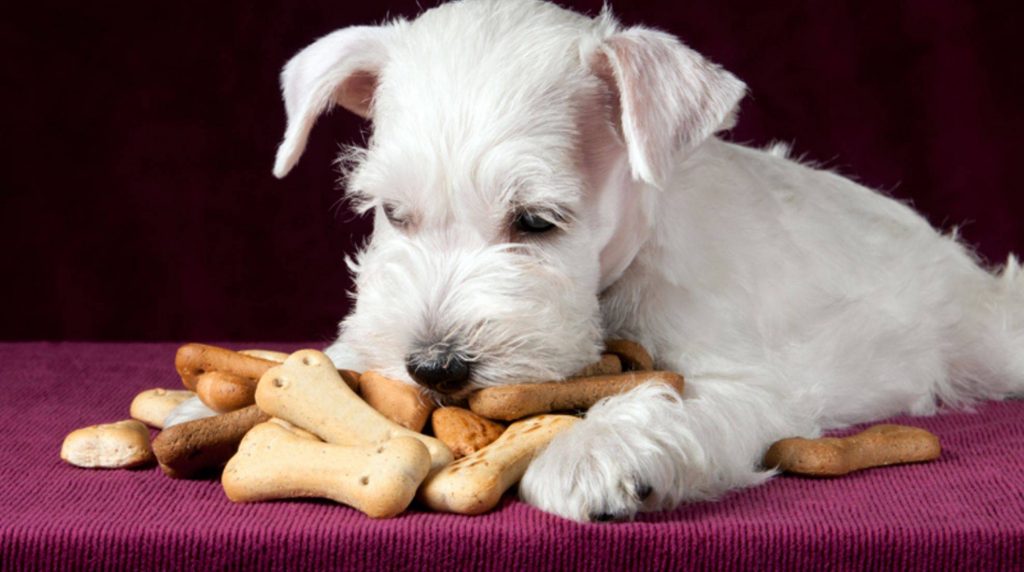
Tip: The dog treats look especially cute and pretty in bone or dog shape. The four-legged friends don’t care about the appearance of the cookies, but as a gift for dog owners – even at Christmas – this is a nice idea.
Gluten-free dog cookies without cereals
You will need these ingredients:
150 g corn flour
3 large carrots
1 ripe banana
Preparation – here’s how:
First wash and peel the carrots and then grate them into fine pieces.
Mash the banana and mix it with the shredded carrots.
Knead the banana-carrot mash with the cornmeal to form a dough. If the consistency is too firm, add a little more water.
Roll out the dough and cut out small cookies.
Bake the grain-free dog cookies at 180 degrees Celsius convection oven for about 20 minutes.
Let the treats cool on a cooling rack.
Bake cheese cookies for dogs yourself
You will need these ingredients:
200 g (cooled) cooked rice
50 g grated cheese
200 g parmesan
50 g cream cheese
1 tablespoon vegetable oil
1 egg
70 g flour
1 small sprig of rosemary
Preparation – here’s how:
Mix rice, all cheeses, oil and egg in a bowl.
Mash the mixture until you get a porridge without big pieces.
Mix the flour into the mixture with a fork until you have a dough that can be rolled out.
Roll out the dough and cut out the dog cookies with ramekins.
Bake the treats in the oven at 180 degrees Celsius convection for about 20 minutes and let them cool well afterwards.
Make barf-suitable dog treats yourself
You will need these ingredients:
150 g coconut flour
1 egg
2 tablespoons coconut oil
100 ml water
250 g pureed rabbit liver
Preparation – here’s how:
Mix all ingredients thoroughly until you have a spreadable dough.
Spread the dough on a silicone baking mat and spread everything well into each well.
Bake the treats at 160 degrees Celsius convection oven for 30 minutes.
Let the dog cookies dry again at 50 degrees Celsius convection oven for 45 minutes.
Note: Dog cookies are treats. Too much can lead to obesity in the animal. Therefore, you should only feed the cookies sparingly to your dog. Because first and foremost, he is still a carnivore. And that is exactly what should be predominantly on his diet.